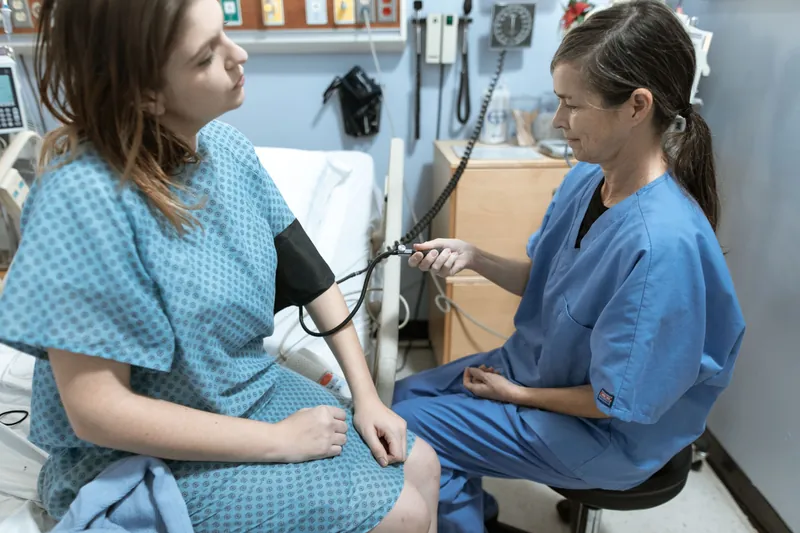
A CNA (certified nursing assistant) is faster to become: federal rules set the minimum training at 75 hours, and many courses take a few weeks. A medical assistant pays more, with a median of $45,690 a year in May 2025 compared with $42,260 for nursing assistants. Choose CNA if you need to start work soon or plan to go into nursing. Choose medical assistant if you can train for 1 to 2 years and want to work in a doctor's office or clinic.
Figures and rules checked October 29, 2026. Pay is from the Bureau of Labor Statistics (BLS) for May 2025.
Medical assistant vs CNA side by side
This table compares the two jobs on training, pay and outlook. Pay figures are medians, so half of workers earned more and half earned less.
| CNA (nursing assistant) | Medical assistant | |
|---|---|---|
| Minimum training | 75 clock hours under federal rules. Some states require more. | No federal minimum. Most programs take about 1 to 2 years. |
| Credential | State competency exam and the state nurse aide registry | Optional national certification, such as CCMA, CMA (AAMA) or RMA |
| Median pay, May 2025 | $42,260 a year | $45,690 a year ($21.97 an hour) |
| Jobs, 2025 | About 1.5 million | 833,900 |
| Job growth, 2025 to 2035 | 3% for nursing assistants and orderlies (about average) | 13% (much faster than average) |
| Largest employer | Skilled nursing facilities (36%) | Offices of physicians (56%) |
| Typical work | Bathing, dressing, moving and feeding patients, and checking blood pressure and temperature | Taking patient histories, helping doctors during exams, collecting lab specimens and booking appointments |
Source: BLS Occupational Outlook Handbook, Nursing Assistants and Orderlies, and Medical Assistants. 42 CFR 483.152.
Which is faster, CNA or medical assistant
CNA training is faster. Federal rules require at least 75 clock hours, including at least 16 hours of supervised hands-on practice. Medical assistant programs usually take about 1 to 2 years, according to BLS.
This table shows how long the programs were that schools reported for 2023–24.
| Award level, 2023–24 | CNA | Medical assistant |
|---|---|---|
| Certificate, under 12 weeks | 79% | 1% |
| Certificate, 12 weeks to under 1 year | 19% | 19% |
| Certificate, 1 to 2 years | 2% | 71% |
| Associate degree | Under 1% | 9% |
These shares come from schools that take part in federal student aid. BLS says CNA programs are also run by high schools, hospitals and nursing homes. Courses at places that don't take federal aid are not in this data.
Source: 42 CFR 483.152. BLS Occupational Outlook Handbook. IPEDS 2024 Completions (program codes 51.3902 and 51.0801).
Which pays more, CNA or medical assistant
Medical assistants earned $3,430 a year more than nursing assistants at the median in May 2025. That is $45,690 compared with $42,260. Pay for both jobs varies by state and employer, so check local wages on careeronestop.org.
Medical assistant jobs are also growing faster. BLS expects them to grow 13% from 2025 to 2035, compared with 3% for nursing assistants and orderlies. Nursing assistants hold more jobs today, at about 1.5 million.
See CNA and medical assistant programs near you
Source: BLS Occupational Outlook Handbook, May 2025 pay and 2025–35 projections.
CNA training hours by federal rule and by state
Every state-approved CNA program must include at least 75 clock hours of training under 42 CFR 483.152. At least 16 of those hours must be supervised practical training, done in front of a registered nurse or licensed practical nurse. Another 16 hours on topics such as infection control, safety and residents' rights must come before you have any contact with a resident.
States can set a higher minimum. California, for example, requires 160 hours: 60 hours in the classroom and 100 hours of supervised clinical training. Ask your state's health department or nurse aide registry for its current hour rule.
Federal rules also limit what you pay in some cases:
- A nursing home that employs you, or has offered you a job, when you start training cannot charge you for the program or its books.
- Say a nursing home hires you within 12 months after you finish. The state must then pay back part of your training cost while you work there.
Source: 42 CFR 483.152(a) to (c). California Department of Public Health, Nurse Assistant Training Program requirements.
How the state CNA registry works
After you finish an approved program, you pass your state's competency exam and go on the state nurse aide registry. Every state must keep this registry under federal rules. BLS says you must be on it to work in a nursing home.
The registry lists your name and the date you qualified. It also records any finding of abuse, neglect or theft of a resident's property. If you go 24 months in a row without doing paid nursing or nursing-related work, the state must remove you from the registry. Your state decides what you must do to get back on it.
The state cannot charge you a fee to be listed on the registry.
Source: 42 CFR 483.156. BLS Occupational Outlook Handbook, Nursing Assistants and Orderlies.
Medical assistant certification
Most states don't require medical assistants to be certified, BLS says, but employers may prefer or require it. The most common options are the CCMA from the National Healthcareer Association, the CMA (AAMA) and the RMA from American Medical Technologists. Our guide to CCMA vs CMA compares who can test, fees and renewal.
The letters CMA can mean two things. For medical assistants, CMA (AAMA) means Certified Medical Assistant. Some states offer CNAs a different credential, the Certified Medication Assistant, which lets them give medications.
Source: BLS Occupational Outlook Handbook, Medical Assistants, and Nursing Assistants and Orderlies. AAMA.
Which job suits whom
CNA suits you if you want to start working in weeks or plan to become a nurse. Most CNAs work in nursing homes and hospitals. The work is physical, since CNAs turn, reposition and move patients between beds and wheelchairs.
Medical assistant suits you if you can spend 1 to 2 years in training and want to work in a clinic. Most medical assistants work in doctors' offices, so the work mixes patient care with office tasks. Some medical assistants later move into nursing, as our guide to the medical assistant to RN path explains.
If you plan to become an LPN or RN, CNA work puts you on a nursing team. BLS says nursing assistants report patients' concerns to nurses. For the next step, see LPN vs RN.
Source: BLS Occupational Outlook Handbook, Work Environment tabs.
Can you use FAFSA for CNA or medical assistant training
You can usually use FAFSA for a medical assistant program at a school that takes federal aid. In 2023–24, 80% of medical assistant awards were for programs of 1 year or longer. A program generally needs at least 600 clock hours over 15 weeks to qualify for Pell Grants.
Most CNA courses are too short for Pell. Some CNA programs of 150 to 599 clock hours over 8 to 14 weeks may qualify for the new Workforce Pell Grant. The state and the U.S. Department of Education must approve each one. See CNA programs that accept FAFSA for schools by state.
Source: 34 CFR 668.8, program length rules. Workforce Pell: Public Law 119-21. IPEDS 2024 Completions.
Questions to ask before you enroll
- How many hours is the program, and does it meet my state's minimum?
- Does it prepare me for the state CNA exam, or for which national medical assistant exam?
- Is the exam fee included in the price?
- Is the program eligible for Pell Grants, Workforce Pell or federal loans for 2026–27?
- If I take a CNA job at a nursing home, will it pay for my training?